


Call Us Now
Jannie Ye: +86 17728636936
Jenny: +86 18127522581
Miriam: +86 15018897468

Views: 0 Author: Site Editor Publish Time: 2026-03-18 Origin: Site
When an excavator starts to show unusual rotation behavior—whether it’s a grinding noise, delayed swing response, or unstable movement—many operators and buyers immediately face the same question: is the issue coming from the motor, the gearbox, or the complete swing system? Understanding this difference is not just a technical detail; it directly affects maintenance cost, downtime, and purchasing decisions. This is where a clear understanding of the swing gearbox becomes essential. As a professional manufacturer of swing reducers and travel reducers, LB has worked with global customers since 2008 to help them identify the right component quickly and avoid unnecessary replacement.
The swing system of an excavator is a coordinated assembly. The motor generates rotational force, while the gearbox adjusts that force to a usable level. Because these components are physically connected and operate simultaneously, many users treat them as a single unit.
In daily operation, the operator only experiences the final motion—smooth or unstable rotation—without seeing which internal part is responsible. This makes it easy to assume that any swing problem requires replacing the entire assembly.
In the global aftermarket, terminology varies widely. Some suppliers use “swing drive” to describe the complete unit, while others refer only to the gearbox or the motor. Listings may include both components together or sell them separately, which adds to the confusion.
For buyers sourcing internationally, inconsistent naming can lead to incorrect orders, especially when matching only by appearance rather than function.
The term “swing drive” is often used as a general label. In some cases, it refers to a gearbox with a motor attached. In others, it may only refer to the reduction unit. Without understanding the internal structure, buyers may misunderstand what they are purchasing.
The swing motor is responsible for converting hydraulic energy into mechanical rotation. It receives pressurized oil from the hydraulic system and generates the initial rotational movement required to turn the excavator upper structure.
This means the motor controls the start, stop, and speed of the swing motion, making it essential for responsiveness and control.
The motor’s performance depends on hydraulic flow and pressure. It does not directly provide the high torque needed to move heavy loads; instead, it supplies rotational energy that must be adjusted by another component.
This is why even a fully functional motor cannot deliver proper performance without a matching gearbox.
Motor-related issues often show up as:
Weak or inconsistent rotation under load
Delayed response when starting swing
Hydraulic oil leakage around the motor
Overheating during continuous operation
These symptoms usually indicate problems with hydraulic pressure, internal seals, or wear in motor components.
The gearbox plays a critical role in converting high-speed, low-torque input into low-speed, high-torque output. This is necessary because excavators require strong rotational force to move heavy upper structures and loads.
Without this reduction process, the motor alone would not be able to deliver sufficient torque.
Most swing gearboxes use a planetary gear structure. This design distributes load evenly across multiple gears, improving durability and allowing compact size with high torque output.
This structure is especially important in excavators where space is limited but performance demands are high.
Over time, continuous heavy loads lead to gear wear, bearing fatigue, and internal clearance changes. When this happens, the gearbox may produce:
Abnormal noise
Increased backlash
Reduced efficiency in torque transmission
These issues directly affect the stability and precision of the swing movement.
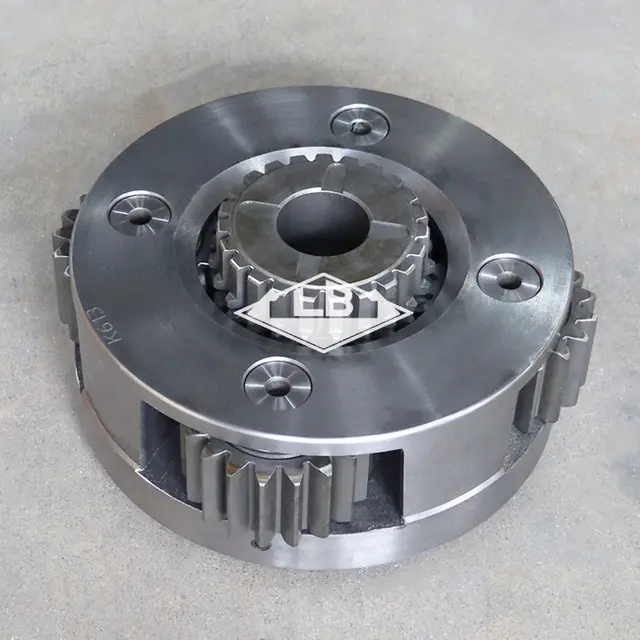
The gearbox is the main contributor to torque output. While the motor provides rotational energy, the gearbox determines how that energy is transformed into usable force.
If torque is insufficient, the issue is often related to gearbox performance rather than the motor itself.
Gearbox wear typically presents as mechanical symptoms such as grinding sounds, vibration, or looseness. These are signs of internal gear or bearing damage.
Motor issues, on the other hand, are more likely to involve hydraulic behavior rather than mechanical noise.
In heavy-duty environments such as mining or demolition, gearboxes are subjected to higher stress and are more likely to wear faster. In lighter applications, motor-related issues may appear earlier due to hydraulic system variations.
Understanding the working environment helps determine which component is more likely to fail.
This may be caused by either insufficient hydraulic power or reduced torque output. Careful inspection is needed to determine whether the issue lies in the motor or the gearbox.
These are strong indicators of gearbox damage. Internal gear wear or bearing failure is usually the cause.
These symptoms often point to motor-related issues, although they can sometimes be connected to overall system problems.
In many cases, symptoms are not exclusive to one component. For example, a worn gearbox can cause the motor to operate under higher stress, leading to secondary issues.
This is why accurate diagnosis is essential before making a replacement decision.
If the gearbox shows no mechanical wear and the issue is clearly related to hydraulic performance, replacing only the motor may be sufficient.
When there is visible gear damage, abnormal noise, or excessive backlash, the gearbox should be repaired or replaced to restore proper function.
If both components show signs of wear, or if the system has been operating under heavy stress for a long time, replacing the full assembly may reduce long-term risk and maintenance costs.
Accurate model identification is the first step. Even within the same brand, different series may use different gearbox configurations.
Matching the OEM number ensures correct fit. Mounting dimensions and connection interfaces must also be verified.
The gearbox must match the required reduction ratio and torque output. Choosing the wrong ratio can lead to poor performance or premature wear.
Component | Main Function | Power Output Characteristic | Common Failure Signs | Usual Buyer Action |
Swing Motor | Converts hydraulic energy to rotation | High speed, low torque | Leakage, weak response, overheating | Check hydraulic system or replace motor |
Swing Gearbox | Reduces speed, increases torque | Low speed, high torque | Noise, backlash, gear wear | Repair or replace gearbox |
A clear understanding of the relationship between the swing motor and gearbox helps buyers make better decisions, avoid unnecessary replacements, and reduce downtime in real operations. At LB, we focus on delivering reliable swing reducers and complete solutions that match different excavator models and working conditions, helping customers worldwide improve performance and efficiency. If you are evaluating your equipment or planning a replacement, feel free to contact us for support and product details related to your rotary drive gearbox.
1. What is the main difference between a swing motor and a swing gearbox?
The motor generates rotational power, while the gearbox converts that power into usable torque for the excavator’s upper structure.
2. Can a damaged swing gearbox affect the motor?
Yes, increased resistance in the gearbox can put additional load on the motor, leading to further issues.
3. How do I know if I need to replace the swing gearbox?
Signs such as grinding noise, metal debris, or excessive backlash usually indicate gearbox wear.
4. Is it better to replace the complete swing drive?
If both motor and gearbox show wear, replacing the full assembly can improve reliability and reduce long-term maintenance.
