




Call Us Now
Jannie Ye: +86 17728636936
Jenny: +86 18127522581
Miriam: +86 15018897468

Views: 0 Author: Site Editor Publish Time: 2026-11-16 Origin: Site
Heavy equipment downtime carries a massive financial burden. When a machine stops working, you immediately face idle crew costs, missed project deadlines, and potential penalty clauses. Saving a marginal percentage on unverified components often results in exponential losses through lost productivity and secondary machine damage. Fleet managers and owner-operators currently navigate a saturated, opaque market of component manufacturers. This environment makes it incredibly difficult to source reliable excavator replacement parts that meet exact operational tolerances without overpaying simply for a brand name.
You need a systematic, engineering-focused framework for evaluating components before making a purchase. Verifying compatibility, auditing suppliers, and understanding component metallurgy are non-negotiable steps. This guide provides a direct approach to assessing replacement parts, ensuring maximum machine uptime, and maintaining predictable long-term operational costs.
Strict Serial Number Verification: Relying on visual similarity or basic model numbers leads to catastrophic fitment issues; exact engine and machine serial number matching is non-negotiable.
Component-Specific Scrutiny: High-torque assemblies like an excavator final drive replacement or travel gearbox replacement require rigorous inspection of internal metallurgy, seal integrity, and bearing load ratings.
Lifecycle Value over Upfront Price: Evaluating aftermarket excavator parts requires calculating expected lifespan, warranty coverage, and installation labor against the initial purchase price.
Supplier Accountability: A reliable excavator parts supplier must provide transparent material specifications, verifiable warranties, and technical support for post-installation troubleshooting.
Unplanned excavator downtime drains project budgets rapidly. Beyond the immediate cost of the broken part, operators must calculate the hourly rate of an idle crew, the rental cost of replacement machinery, and the financial penalties associated with delayed project milestones. Procurement decisions must operate as a risk management exercise rather than a simple purchasing task. Buying a substandard component introduces massive operational risk into your fleet.
To mitigate this risk, you must establish strict baseline success metrics for every part you source. You cannot afford to guess whether a part will hold up under load. Evaluate your procurement strategy against these three primary metrics:
Dimensional Accuracy: The component must align perfectly with factory mounting points without requiring modification, shimming, or forced fitment. Forced fitment introduces stress fractures before the machine even starts.
Material Durability: Steel alloys and hardening depths must match the operational demands of the specific machine weight class. A gear designed for a 15-ton machine will shatter instantly if installed on a 30-ton excavator.
Lead Time to Delivery: Procurement speed directly impacts fleet availability. Sourcing a cheaper part that takes six weeks to arrive by sea freight negates any upfront savings due to the extended machine downtime.
Original Equipment Manufacturer (OEM) parts come directly from the company that built the machine. They offer guaranteed fitment, standard warranties, and consistent quality. However, this reliability comes at a high premium. Conversely, aftermarket excavator parts present a highly variable market. While they offer the potential for significant cost savings, they require strict vetting to ensure reliability.
The aftermarket is not a single entity; it exists in tiers. Premium aftermarket manufacturers often supply the OEMs directly. They produce components using the same metallurgy, machining tolerances, and quality control standards as the original parts. Low-tier aftermarket suppliers, however, rely on reverse-engineering. They frequently cut corners on material hardening processes and seal quality, leading to premature failure.
Component Category | Recommended Sourcing Strategy | Technical Justification |
|---|---|---|
Proprietary Electronics & Main Control Valves | OEM Only | Requires exact voltage calibration and software handshakes. Aftermarket options often fail to communicate with the main ECM, causing erratic hydraulic behavior. |
Undercarriage Parts (Tracks, Rollers, Idlers) | Premium Aftermarket | Heavy wear items where premium aftermarket steel forging matches OEM quality at a fraction of the cost. Dimensional tolerances are standardized. |
Standard Hydraulic Cylinders & Linkage Pins | Premium Aftermarket | Machining tolerances and chrome plating standards are easily replicated by high-tier aftermarket manufacturers using modern CNC equipment. |
Complex Variable Displacement Pumps | OEM or Certified Remanufactured | Internal volumetric efficiency relies on microscopic tolerances between the piston shoes and the swashplate. Low-tier aftermarket pumps often suffer from internal bypass leaks. |
The final drive operates under immense stress, translating high-speed, low-torque hydraulic power from the pump into the low-speed, high-torque mechanical force required for track movement. When evaluating an excavator final drive replacement, visual inspection is not enough. You must scrutinize the internal planetary gear alignment. The reduction process usually happens in two or three stages. Misaligned gears in any of these stages create uneven load distribution, resulting in rapid tooth wear and catastrophic failure.
Floating face seals serve as primary lifespan indicators. These seals prevent abrasive dirt, mud, and water from contaminating the internal gear oil. Substandard seals degrade quickly, allowing debris to destroy the planetary gear sets. You must also check the hydraulic motor displacement specifications against the original factory data. A mismatch in displacement will cause the machine to track unevenly, pulling to one side during operation. Common failure points in low-quality replacements include premature bearing wear and excessive case pressure buildup, which eventually blows out the main shaft seal.
The swing gearbox manages extreme rotational inertia and massive side-loading forces. When a fully loaded bucket stops rotating, the swing gearbox absorbs the kinetic energy. Assessing an excavator swing gearbox replacement requires a deep dive into the metallurgy of its internal components. Scrutinize the pinion shaft. It must be forged from high-tensile steel, typically 42CrMo or equivalent, to withstand sudden shock loads without shearing.
Ring gear tooth hardening processes separate premium parts from cheap alternatives. Induction hardening provides a tough outer wear surface while maintaining a ductile core, preventing the teeth from snapping under stress. Through-hardening, often used in cheaper parts, makes the entire gear brittle. Always verify the quality of the internal carrier assemblies. Warning signs of a poor-quality swing gearbox include a lack of specified backlash tolerances or undocumented gear ratios. Excessive backlash causes jerky, unpredictable upper structure movement, making fine grading or trenching impossible.
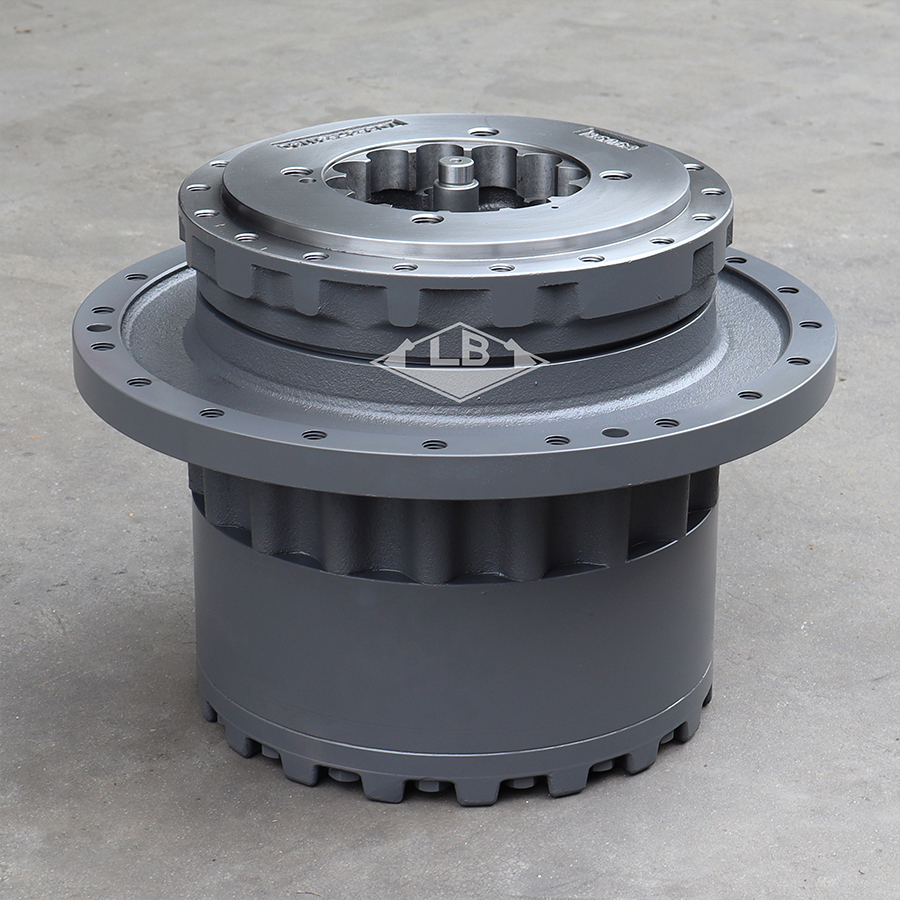
Travel gearboxes operate continuously in abrasive, high-resistance environments. They are submerged in mud, water, and rock. When selecting a travel gearbox replacement, verify the integration between the hydraulic travel motor and the reduction gearbox. The splined connection between these two units must feature exact tolerances to prevent stripping under heavy tractive loads.
Assess the quality of the housing casting carefully. Look closely for porosity, pitting, or casting flaws. Under heavy load, these microscopic imperfections act as stress risers, leading to structural cracking across the housing. The mounting flange must be perfectly flat. Any warpage will cause the mounting bolts to stretch and eventually shear off during operation, dropping the final drive out of the track frame.
Fleet managers frequently face the decision to rebuild a failing component or replace it entirely. Rebuilding makes sense when the main housing remains intact and only specific wear items have degraded. When sourcing individual excavator gearbox spare parts—such as sun gears, planetary gears, thrust washers, and bearings—you must demand technical specifications from the manufacturer.
Verify the Rockwell hardness ratings for all gear teeth. Soft gears will disintegrate within weeks of installation, contaminating the entire housing with metal shavings. Ensure exact dimensional tolerances using micrometer measurements. Relying solely on part numbers often leads to installing gears with incorrect pitch diameters. Furthermore, match the bearing load ratings exactly to OEM specifications. Installing a standard ball bearing where a high-capacity tapered roller bearing is required will result in immediate cage failure under axial load.
Hydraulic system failures range from minor external leaks to catastrophic internal destruction. A minor external leak often requires only a basic seal kit. Catastrophic internal failure, where metal fragments circulate through the system, requires full component replacement and extensive system flushing using a kidney loop filtration cart.
When evaluating replacement hydraulic pumps, verify the volumetric efficiency ratings. Inspect the housing integrity for hairline cracks around the high-pressure ports. Ensure the new pump is perfectly compatible with the machine's existing hydraulic flow rates and pressure relief settings. For hydraulic cylinders, inspect the replacement cylinder rods thoroughly. Proper chrome plating thickness and a flawless surface finish are mandatory. Run a fingernail over the chrome; any micro-pitting will act like sandpaper on the wiper seals, leading to premature fluid bypass.
Undercarriage components operate as a cohesive system. Failing to replace one worn part accelerates the wear on all mating parts. Running a new track chain on a worn sprocket will destroy the new chain bushings rapidly. Timely replacement of sprockets, rollers, and tracks is critical for maintaining fleet efficiency.
Inspect replacement sprockets for the proper tooth profile and hardening depth. Sharp, pointed teeth on your old sprocket indicate it is time for a replacement.
Measure replacement roller diameters against OEM wear limits to ensure they provide adequate clearance for the track chain.
Verify the structural integrity of the track tensioners and recoil springs. These components absorb the impact of rough terrain and keep the track aligned.
Check the track shoe grouser height. Worn grousers reduce traction, forcing the travel motors to work harder and generate excess heat.
Ordering parts based solely on the machine model guarantees fitment issues. Manufacturers implement mid-year production changes, generational updates, and regional variations. A hydraulic pump used in a January build might be completely different from the pump used in a November build of the exact same model year.
You must locate and read the machine identification plate, usually riveted to the lower cab exterior or the main frame. Additionally, locate the specific engine data plate, typically found on the valve cover or engine block. Cross-reference these exact serial numbers with the manufacturer's electronic parts catalogs (EPC). Pay attention to the prefix, the manufacturing code, and the sequential build number. This is the only way to ensure you are ordering the correct revision of a specific component.
Understanding the difference between used and remanufactured parts dictates your inspection process. "Used" means the part was salvaged from a dismantled machine and is sold as-is, carrying significant risk. "Remanufactured" means the component was completely disassembled, cleaned, machined back to factory specifications, and reassembled with new seals and bearings.
Inspection Area | Used Component Red Flags | Remanufactured Component Standards |
|---|---|---|
Structural Housing | Micro-cracks around mounting flanges, active corrosion, evidence of unauthorized patch welding. | Sandblasted, magnafluxed for hidden cracks, repainted, and factory-sealed. |
Internal Wear Surfaces | Galling, pitting on gear teeth, bluing on shafts indicating severe overheating. | Machined to exact tolerances, oversized bearings installed if necessary to compensate for machining. |
Fluid Ports & Threads | Cross-threaded ports, missing fittings, presence of old, burnt hydraulic fluid. | Threads chased and repaired, ports capped with plastic plugs to prevent contamination during shipping. |
If you are buying a used hydraulic component, always request a fluid analysis report. This report reveals the presence of microscopic metal shavings, which indicate severe internal wear that is not visible from the outside.
A warranty is only as strong as the company backing it. Analyze what constitutes a legitimate warranty. A standard 1-year or 1,000-hour coverage plan demonstrates that the manufacturer stands behind their metallurgy and assembly processes. Hollow guarantees that offer replacement only upon factory defect approval often leave operators stranded while the supplier drags out the inspection process.
Identify red flags in return policies before making a purchase. Exorbitant restocking fees and a refusal to cover return shipping for defective parts indicate a supplier lacking confidence in their inventory. Determine exactly what the warranty covers. Does it cover just the replacement part, or does it include secondary damage caused to the machine if the part fails catastrophically?
Evaluating a supplier's technical expertise separates parts brokers from true industry partners. A reliable excavator parts supplier must provide comprehensive post-sale documentation. Ask if they can supply installation manuals, exact torque specifications for mounting bolts, and hydraulic schematic diagrams for complex assemblies.
Assess their ability to assist with troubleshooting. If a newly installed travel motor fails to track straight, can their in-house engineering team help you diagnose whether the issue lies with the component, the swivel joint, or the main control valve? Suppliers lacking this technical depth will simply blame the installation process and void your warranty.
Investigate the supplier's inventory model. Do they hold physical stock locally, or are they merely drop-shipping components from overseas factories? Drop-shipping introduces massive variables in delivery times, customs delays, and quality control.
Calculate the true cost of extended lead times. Saving a small percentage on the purchase price becomes irrelevant if the part takes four weeks to arrive, leaving your machine idle and your crew unproductive. Transparent suppliers provide accurate, guaranteed tracking information and maintain domestic warehouses for critical high-wear components.
The number one cause of premature replacement part failure is hydraulic system contamination introduced during the installation process. Modern excavator hydraulic systems operate at extreme pressures, often exceeding 5,000 PSI. At these pressures, a single particle of dirt or metal shaving acts like a bullet, destroying the microscopic tolerances inside pumps and valves.
Implement strict cleanliness protocols in the field or shop. Before removing the old component, thoroughly pressure-wash the surrounding area. Flush the connecting hydraulic lines completely. Replace all inline and return filters, paying special attention to the case drain filter. Cap all hoses immediately upon disconnection, and never leave open ports exposed to the air. Even airborne dust can compromise a newly installed variable displacement pump.
New mechanical and hydraulic components require specific break-in periods to allow machined surfaces to mate properly. Slapping a new gearbox on a machine and immediately running it at maximum load will cause localized overheating and premature bearing failure.
Operate new gearboxes and hydraulic motors at reduced load and lower engine RPM for the first 50 hours of operation. Monitor the casing temperatures closely using an infrared thermometer. After the initial 50 hours, drain and replace the gear oil to remove any manufacturing debris or initial wear metals. Furthermore, you must check and adjust the hydraulic relief valve pressures. The new component's specifications might require different pressure settings than the worn-out part it replaced. Failing to calibrate the relief valves will result in blown seals or sluggish machine performance.
Locate and document your machine's exact serial number plate and engine data plate before ordering any components.
Compile a comprehensive list of required part numbers using the manufacturer's electronic parts catalog to ensure exact fitment.
Contact a vetted supplier to request technical drawings, material specifications, and clear warranty terms in writing.
Establish a strict cleanliness protocol with your maintenance team prior to beginning the installation process.
Schedule a mandatory gear oil change and pressure calibration check after the first 50 hours of operation.
A: Reliability depends entirely on the tier of the aftermarket manufacturer. Premium aftermarket parts often match or exceed OEM specifications, utilizing identical forging and machining standards. Low-tier aftermarket parts pose significant reliability risks due to inferior metallurgy and poor quality control.
A: Do not rely solely on the machine model. You must match the machine serial number, verify the hydraulic flow rates, and count the exact number of sprocket bolt holes and frame mounting holes to ensure proper fitment and performance.
A: Industry standards for premium replacement gearboxes typically range from 6 months to 1 year, or 1,000 operating hours. Always check the fine print to determine if the warranty covers replacement labor or just the physical component.
A: Inspect the parts meticulously for gear tooth pitting, galling, and uneven wear patterns. Verify bearing tolerances using micrometers. Utilize non-destructive testing methods like dye penetrant inspection to check for hairline cracks near stress points.
A: Common causes include improper installation, severe hydraulic fluid contamination, mismatched hydraulic pressures, and failing to replace the gear oil after the initial 50-hour break-in period, which leaves manufacturing debris inside the casing.
A: Evaluate suppliers based on transparent warranty terms, the availability of in-house technical support, a positive industry reputation, and clear return policies that do not penalize the buyer for factory defects.
